

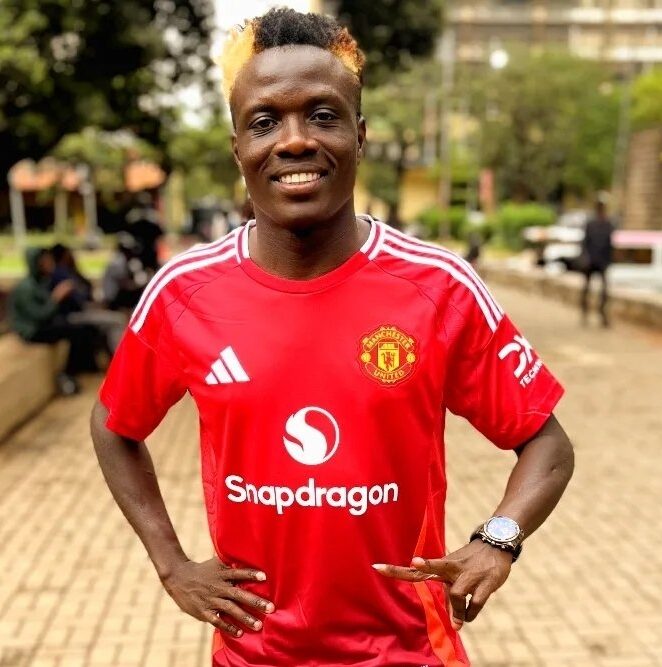
 Kevin Masagara
 Kelly Talksport
Before Manchester United became the club I had to defend every Monday morning, it was simply the club I was beginning to follow.
I started following Manchester United when I was in Class Six, around 2008. At that point, I wouldn’t say I was the die-hard fan I am today. I was just getting interested in the club and following what was happening.
By 2011, though, something had changed.
I remember going to the hall to watch football. That is where the attachment really grew for me. You weren’t sitting alone watching the game. You were surrounded by other people who loved football, experiencing every tackle, every chance, every goal, and every controversial decision together.
Those moments made the club feel much closer.
Manchester United stopped being just a team I followed.
At the time, I had no idea where that attachment would eventually take me. I wasn’t thinking about social media, content creation, followers, or building a career around football.
I was simply a young fan who wanted to watch Manchester United play.
Looking back now, that is probably what makes the journey even more interesting. What started in Class Six and grew through those afternoons and evenings watching football in the hall eventually became something that shaped a huge part of my identity.
I didn’t know then that I was signing up for years of arguments, heartbreak, banter, celebrations, and emotional damage.
I just knew I wanted to watch United.
And once you fall in love with a football club like that, you don’t really get to choose when the relationship becomes serious. You just keep coming back.
Being an ordinary Manchester United fan is already a full-time, hazard-pay occupation. Being a Manchester United fan on Kenyan social media? That is a spiritual trial. When United lose, you don’t merely surrender three points on a pitch in Greater Manchester. You forfeit your peace of mind, your blood pressure, and your constitutional right to a quiet Sunday evening.
The referee puts the whistle to his lips, and just like that, your weekend is liquidated flat and mercilessly. Your phone sits in your palm radiating hostile energy like unexploded ordnance, a live grenade counting down in glass and aluminum.
You don’t need a prophet to decipher the notifications stacking up against the glass: memes carefully marinated in malicious joy, unprovoked tags, and lengthy voice notes recorded with unwarranted enthusiasm.
Suddenly, Arsenal supporters have somehow evolved into elite tactical theorists with doctorates in half-spaces and low blocks, which is remarkably poetic for a fanbase whose club has historically evaded the Champions League trophy.
An intellectual coping mechanism, no less.
Chelsea fans—of all people—suddenly remembering how to speak, bravely shouting tactical advice from their languishing depths of the mid-table wilderness.
Even aunties who couldn’t tell a corner kick from an offside trap are casually forwarding WhatsApp screenshots mocking your misery.
Because I have built my entire digital brand around this football club, I cannot slip out through the back door. There is no discreet departure. Nairobi knows my handles, and Nairobi keeps receipts. Sometimes, after a catastrophic ninety minutes, the spirit whispers: Masagara, just log off and touch grass for twelve hours. But then reality strikes. You cannot hold carnival parades on the timeline during the glory days and then stage an emergency blackout the moment Casemiro mistimes a tackle.
That is not how we do things on this side of the planet.
I have dished out plenty of banter with compound interest, so when the bill arrives, I must swallow the invoice like an adult. Yet here is the real sickness: after enduring seventy-two hours of unfiltered mockery, Friday arrives, and the optimism starts creeping back like a fever. By Saturday morning, I am pacing the room, utterly convinced: “This one, surely, we are winning.”
It makes no clinical sense. That is Manchester United for you.
Our generation of United supporters was hopelessly spoiled. If your football consciousness was forged under Sir Alex Ferguson, you grew up believing victory was a fundamental human right. You woke up expecting silverware the way ordinary citizens expect sunrise. Opponents didn’t just play United; they showed up at Old Trafford looking like suspects appearing before a harsh magistrate.
Then Sir Alex walked out into the Manchester drizzle, and football ceased to be a joyride. It became an existential test.
You transition from watching a well-oiled winning machine to watching an erratic circus that makes you doubt your own eyesight. One weekend you are singing hymns, convinced the Renaissance has arrived; the next Saturday you are sitting with your hands on your head, wondering what tactical abomination has just played out on your screen.
Yet this is where loyalty stops being cheap sloganeering. Anyone can support a winning football team—celebrating silverware is the easiest assignment in sports. The real test is staying planted in the trenches when the rival banter is louder.
I have lost my voice shouting at television screens.
I have questioned substitutions and openly lamented player attitudes along with every other exhausted red on the internet.
But not once have I looked for the nearest exit.
Fandom was never a commercial transaction where the club delivers trophies on a silver tray, and I remit my loyalty on a monthly subscription.
It is personal.
I have invested too much emotional capital into this club to walk away simply because the roof is leaking.
We are suffering, yes—but we suffer together, with our chests out. Like real men do.
There is a strange, patronising myth among European purists that if you sit five thousand miles south of the equator, your football passion is merely a diluted simulation.
To those people, I have a very simple proposition: land in Nairobi on a Premier League derby afternoon, leave your passport at the hotel, and take a walk.
You will find a city that reorganises its entire socio-economic rhythm around a 4:30 PM kick-off.
You will find small businesses, roadside kiosks, and car washes running match commentary as ambient noise. Step into a viewing base in the estates—packed to the rafters with sweating, agitated Kenyans who have never laid eyes on each other, yet stand shoulder-to-shoulder, joined at the hip by identical red shirts.
When United score, you do not need to sit in the Stretford End to feel the earth shake. The roof threatens to come off. Strangers embrace with the fierce energy of long-lost brothers. Someone is screaming at the ceiling, another person is frantically live-streaming the chaos, and three people are already dialing their Arsenal friends just to shout unprintable things down the line.
This game gave us a lingua franca. I have forged genuine friendships across Nairobi simply because we spotted each other wearing the same jersey at a petrol station.
Distance does not dilute the bloodline.
I have supported this club from the bustling streets of Nairobi. I have celebrated, screamed, and grieved from here.
It is woven into who I am.
When I first hit record on my phone, there was no five-year master plan to engineer an audience of seven figures. I was simply a young man in love with a football club, possessing an excess of opinions and an urgent need to talk about them.
Then people stopped scrolling. Then they hit follow. Then they started waiting for my post-match post-mortems like people waiting for election results.
Somewhere along the line, the realization landed: Wait a minute—people actually care what this guy from Nairobi thinks.
The secret was never complicated: zero filter. If we win, you see the unadulterated joy of a boy who thinks he owns the world. If we get humiliated, you see the raw, unedited heartbreak of a man who feels personally betrayed by an errant back-pass. Kenyans can smell plastic from across the country; they stayed because they recognized a brother whose weekend had been genuinely ruined just like theirs.
That authenticity is what I think people connected with.
Crossing the one-million milestone was surreal. It forces you to pause and appreciate how an obsession born on estate benches can travel across borders. But you cannot let numbers inflate your head.
I remain the same supporter pacing the floor on matchday.
The only difference now is that when my heart breaks, a million people are watching it shatter in high definition.
Yet the longer I have occupied this space, the sharper one uncomfortable irony has become: we possess an endless appetite to debate Manchester, North London, or Merseyside, yet we treat our own domestic game like an afterthought.
We can rattle off the third-choice left-back at West Ham, his injury record, and his weekly wage down to the last pence.
But ask about an exceptional teenager lighting up the Kenyan Premier League or making waves in the grassroots circuits, and the room falls dead silent.
That silence is an indictment on us as storytellers. Local football does not need to be consumed as dry history lecture.
Football is pure theatre—it is loud, chaotic, humorous, dramatic, and petty.
If we can inject the same electric energy, the same humor, and the same unsparing scrutiny into our own clubs and grassroots talents, our fans will fall in love with them too.
Our kids shouldn’t grow up believing football only lives on European satellite feeds. They need to see that the mud on a pitch in Nairobi carries the exact same soul as the manicured turf in England.
Supporting Manchester United from Nairobi teaches you an enduring truth: loyalty is measured not by how many trophies you collect, but by how many times your heart can be broken into fine dust, only for you to sweep up the pieces and show up again the following week.
And my journey has carried its own peculiar twist of irony. I have spent years living, breathing, and analyzing Manchester United. I built an entire career dissecting ninety-minute matches staged at a ground I had only ever seen through a glowing screen.
Sometimes I have to stop and marvel at the sheer strangeness of this odyssey.
I was just a boy in Class Six back in 2008, peering into the football world. By 2011, I was that kid squeezing onto a wooden bench in a crowded hall, completely consumed by ninety minutes of running, shouting, and drama. Back then, I didn’t know that the club I was watching on a grainy screen would quietly chart the entire trajectory of my life.
Manchester United became far more than ninety minutes of weekend distraction. It became my compass. It shaped my identity, dictated my friendships, and gave me a vocabulary to connect with total strangers across Nairobi.
Then the camera entered the frame, and the scale exploded. What was once a solitary release became a communal ritual shared by hundreds of thousands, and eventually millions.
That transition is something I never take lightly.
When United play, people don’t just watch the pitch; they wait for my reaction. My inbox lights up before kickoff, during the tension of extra time, and the moment the final whistle blows. Some people come to celebrate. Some come to pick fights over team selections.
Others arrive with pure malice in their hearts, eager to see the exact degree of devastation across my face after an away defeat.
That dynamic proved to me that this journey had outgrown my personal fandom.
My followers didn’t just watch my matchday; they became part of it, just as I had become part of theirs.
People message me saying they learned how to read a football match through my videos. Others admit they began supporting United because of the laughter and camaraderie on my timeline. Many just come for the therapy of communal debate—to laugh, argue, and belong. That human connection is what anchors this whole journey.
Follower counts are vanity metrics on a screen; human connection is reality.
I think, too, of those closest to me. My family and friends have watched this thing morph from a stubborn teenage obsession into a viable livelihood. They were there for the late nights, the editing marathons, the quiet heartbreaks, the viral triumphs, and the heavy silences when life didn’t go to plan.
Above all, they know how deeply this club runs in my veins.
So when people ask why Old Trafford matters so much to me, they are missing the point entirely.
It is not a sightseeing holiday. It is not about snapping polished photos for Instagram or checking a Premier League stadium off a tourist bucket list. For me,
Old Trafford represents the astronomical distance this journey has covered.
I began as a nameless kid in Kenya watching Manchester United from a neighbourhood hall. Standing inside Old Trafford would mean standing at the intersection of a childhood dream and an impossible reality.
It is the physical manifestation of how far a boy with a phone, a jersey, and an unwavering voice can travel.
For years, I have watched other people walk through those famous gates. I have watched players emerge from the tunnel, seen the Stretford End detonate into madness, and heard the roar vibrating through my phone speakers.
One day, I want that deafening roar to hit my actual chest.
I want to walk down Sir Matt Busby Way, look up at the red brick, and whisper to that Class Six boy in the hall: We actually made it here.
That dream is no longer just mine. My audience has claimed a stake in it too.
Every day, people ask about Old Trafford. They drop into my comments, reminding me that the pilgrimage must happen. They want to see the tears. They want to witness the disbelief. They want to live that moment right alongside me.
And that is why, when that day finally arrives, I will not be walking into Old Trafford alone.
I will be carrying every single person who has walked this road with me. The loyal subscribers who defended me in the comments; the casual scrollers who paused to laugh at my misery; the friends who shared my early videos when nobody cared; and yes, even the relentless Arsenal and Chelsea fans who set their alarms just to mock me on Sunday nights.
They are all woven into the fabric of this story.
Old Trafford will be the destination, but the true masterpiece is everything that happened in the trenches beforehand.
When the one-million mark arrived, the universe seemed to nod. Public figures stepped forward; promises were made in broad daylight to finally fly me to Old Trafford. For a brief moment, the distant myth became tangible. I could already picture the walk down Sir Matt Busby Way, the cold Manchester air hitting my chest, the breeze of the tunnel, the green expanse of the Theatre of Dreams.
Then came the red tape. Visas stalled, logistical hurdles mounted, and the plane departed without me.
Did it sting? Immensely.
But it did not chip away at the foundation. A delayed flight does not invalidate the journey. I am still that boy from Nairobi. When the whistle goes this weekend, I will put on the red shirt, clear my throat, brace for the incoming banter, and dare to believe all over again.
I chose Manchester United. And after everything, I am still standing right here.
Because I didn’t choose to suffer like this.
Have any thoughts?
Share your reaction or leave a quick response — we’d love to hear what you think!
-
 1
1
-
 2
2
-
 0
0
-
 0
0
-
 0
0
-
 0
0
 Ammaton Samunya
 Joseph Okwisia
 Allan Wanga
 Samwel Ogor
2 comments
Magnificent superfan big up bros masagara
Interesting story from our brother Kevin Masagara and it still remind me that not all come with the privilege that others have but we have push everyday every hour every minute and every second we breathe